The most interesting design decision in the Coach Charm Playground at Selfridges is not the Rexy slide, as spectacular as that is. It is the shift in spatial logic. Coach’s visual vocabulary, the charms, the bag, the apple, the New York icons, has been scaled from accessory to architecture. You are not standing in a room looking at Coach charms. You are standing inside one.
The Charm Playground ran at the Selfridges Corner Shop on Oxford Street from April 27, produced by StudioXAG, Coach’s long-standing experiential partner. The Corner Shop is one of the most competitive retail spaces in London: a short-tenure, high-exposure slot that Dior, Louis Vuitton, Loewe, Prada and Burberry have all occupied. Each brand uses it differently. Coach used it as a scale experiment, taking every element of the brand’s signature world and expanding it to human size.
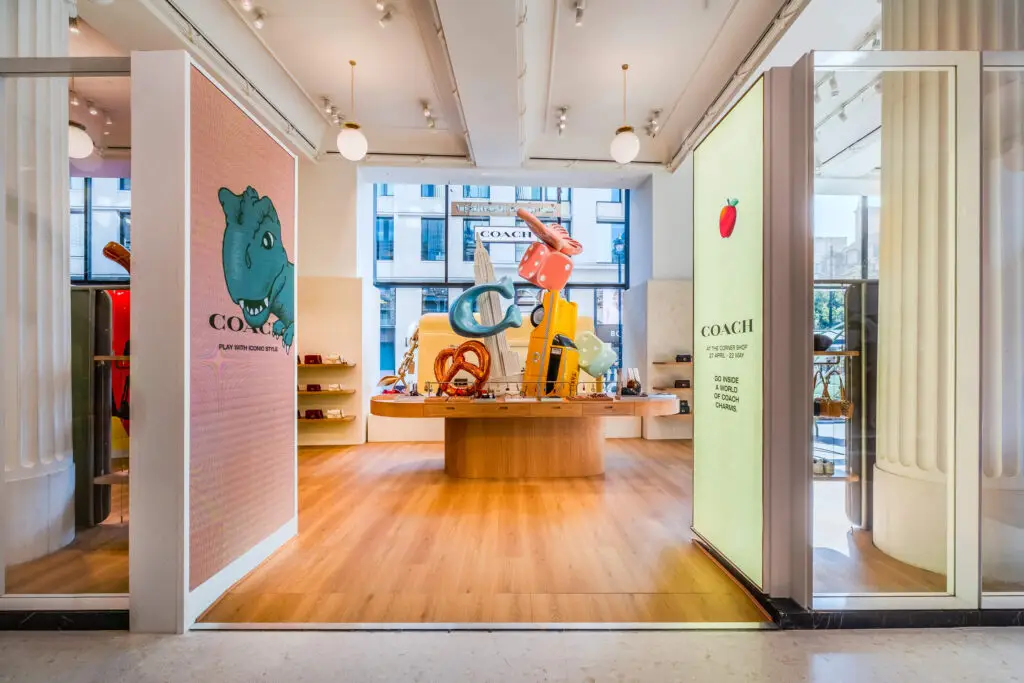
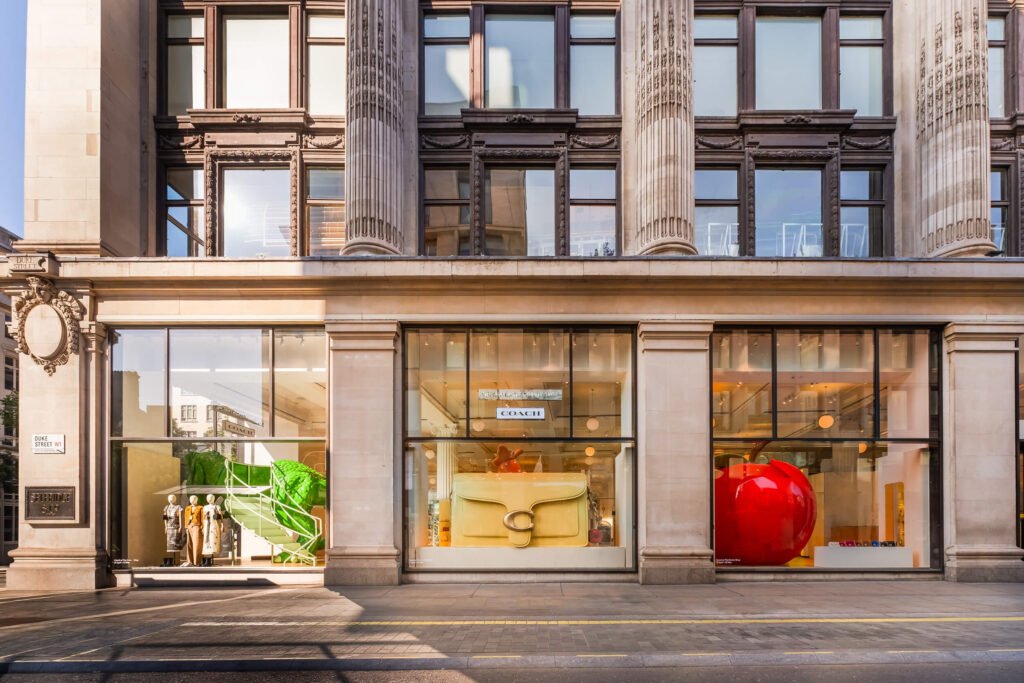
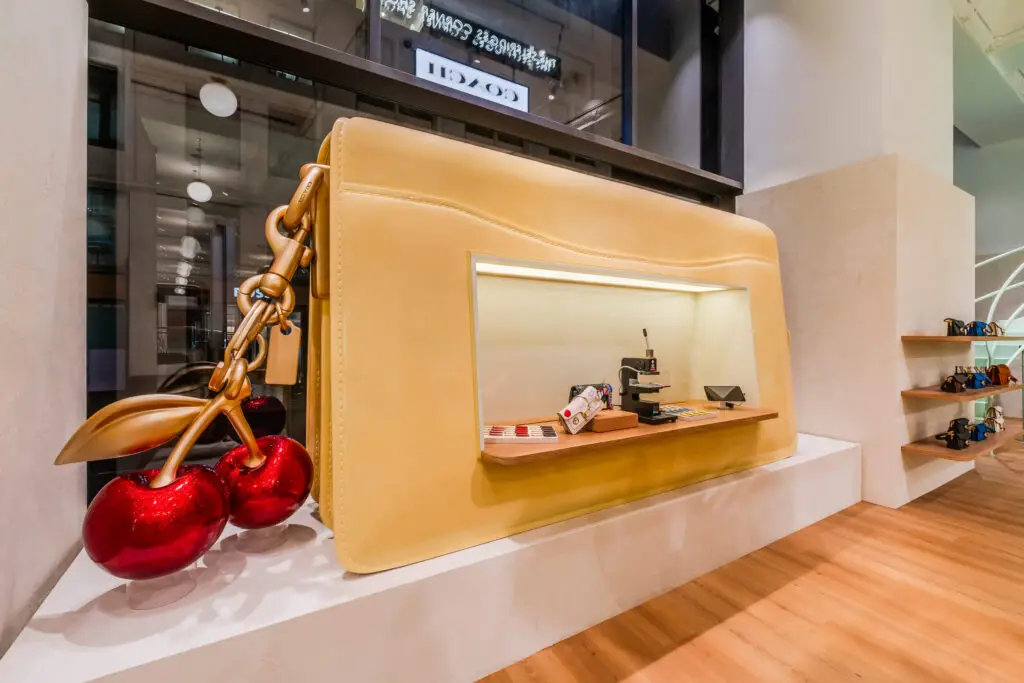
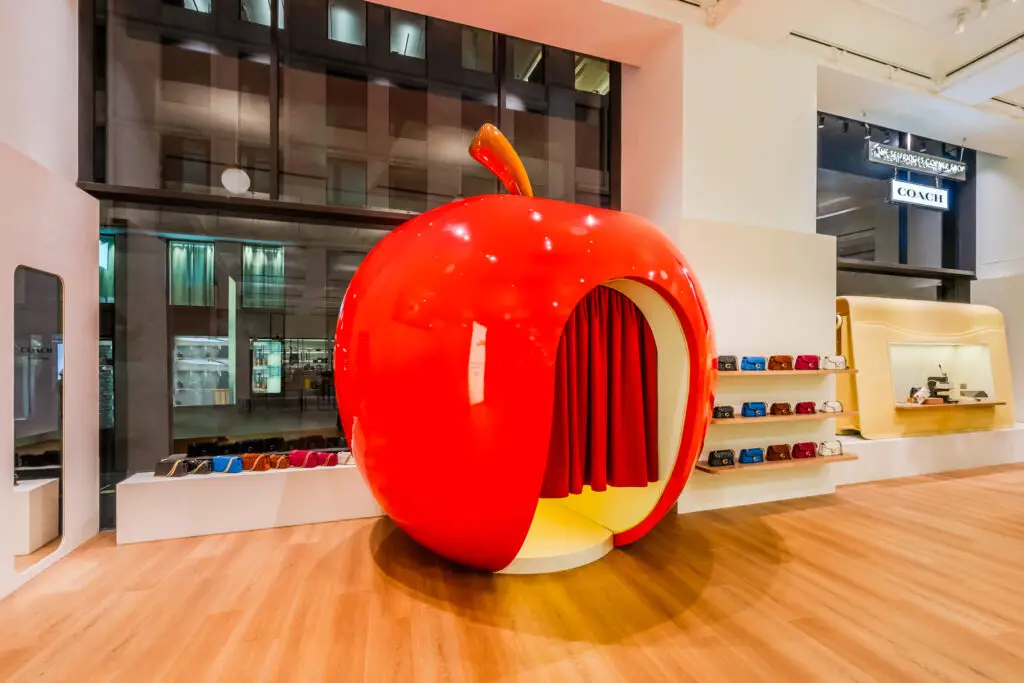
The exterior windows set the premise from the pavement. Three panes across the Selfridges facade each hold a different oversized world: the bright green Rexy looming over a staircase in the left window, the butter yellow Tabby bag with its front cut open as a live monogramming station in the centre, and the lacquered red apple with its curtained interior visible on the right. From the street, the three windows read as a preview of a single coherent idea: everything you know as a Coach charm, at a scale you did not expect.
Inside, the entry is framed by two panels. Left: a cartoon Rexy on candy pink with “Coach / Play with Iconic Style” in block type. Right: lime green with “Go Inside a World of Coach Charms.” The spatial sequence that follows delivers exactly that. The centrepiece sculpture on the oval oak island table stacks a full NYC charm scene upward: a giant glittering orange pretzel at mid-height, the Empire State Building in white behind it, a Coach-branded yellow taxi cab tilted on its side, the Coach C monogram in powder blue, oversized dice tumbling upward. It is everything that has ever appeared on a Coach bag handle, reassembled into a single sculpture well above head height, with charm trays covering the table below it holding hundreds of individual pieces.
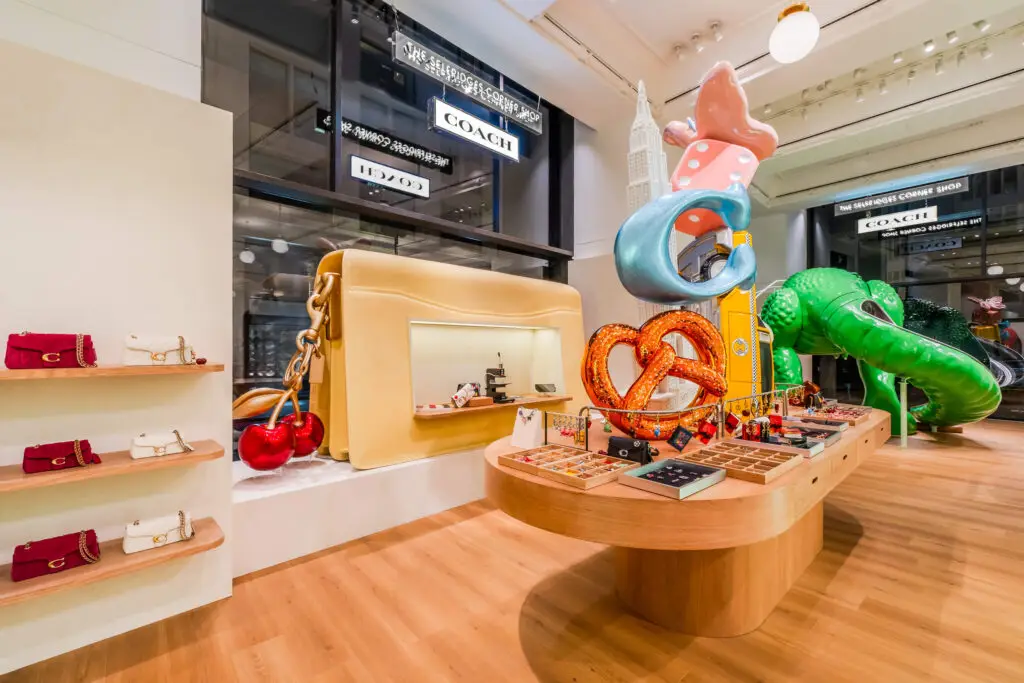
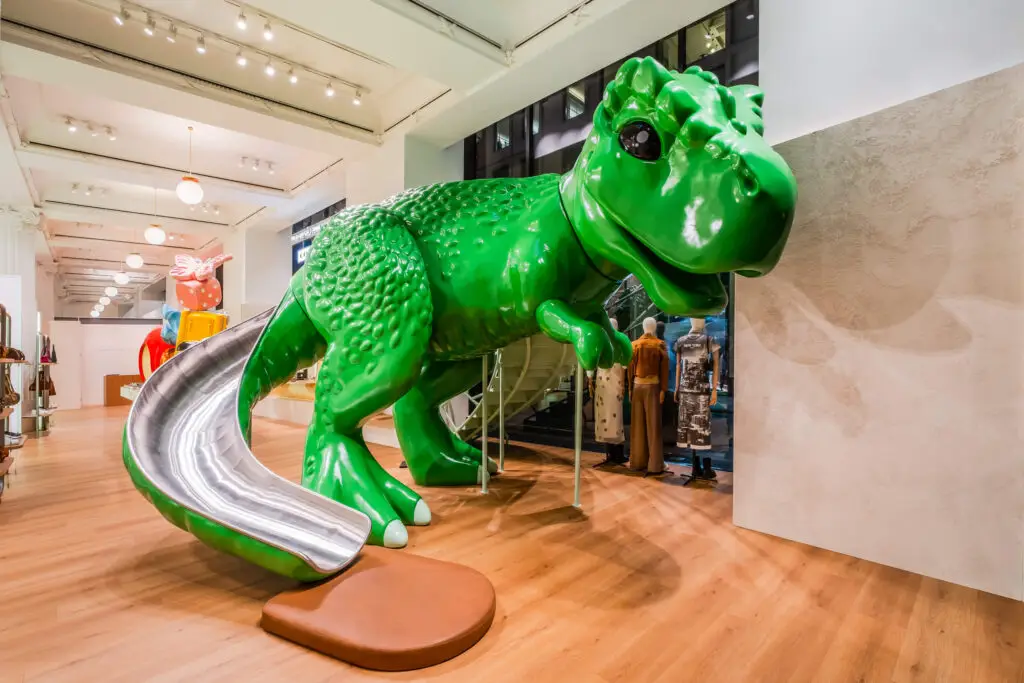
Rexy occupies the rear of the ground floor. The glossy green dinosaur, with its cartoonishly large head and round eyes, has a silver metal slide running from the height of its back to a leather landing pad on the floor. Adults can and do use it. The slide sits next to a mint green staircase to the upper floor, which means Rexy functions as both installation and alternative route. It is the kind of functional absurdity that Coach pulls off better than almost any brand in its tier.
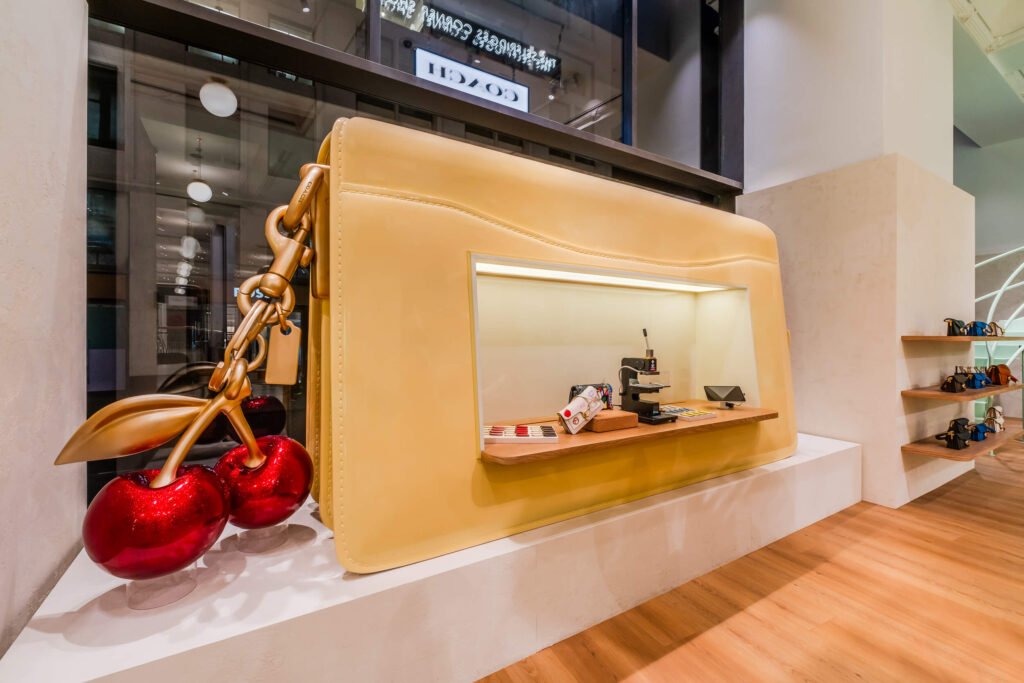
The oversized Tabby is positioned against the window wall, in butter yellow with horsebit hardware scaled to the size of a bicycle, a pair of giant lacquer red cherry charms hanging beside it. A rectangular window is cut into the bag’s face, light-boxed from within, with the monogramming station inside: colour swatches, stamp equipment, paper samples on the internal shelf. You personalise your bag inside a bag.
The red apple, visible through the right exterior window, is a walk-in photo booth. The entrance is curtained in deep red velvet, the interior white. It is immediately legible as a New York reference, Coach’s origin city, the charm that has appeared in its collections for years, now scaled to the size of a small room.
The charm trays at the central table held hundreds of individual pieces: skulls, stars, cherries, mushrooms, letters, book charms, miniature bags. A four-week residency with London fine-line tattoo artist The Social offered another layer of personalisation alongside. Exclusive Tabby colourways in fuchsia and sky blue were available only at the Corner Shop, alongside the Empire and Brooklyn bags, new Kisslock and Turnlock styles, and a curation of runway ready-to-wear.
Giovanni Zaccariello, Coach’s SVP of Visual Experience, described the intent as wanting people to “tap into their inner child and regain a sense of wonder through our Coach icons.” The Charm Playground earns that ambition spatially. The wonder does not come from nostalgia or graphic decoration. It comes from standing inside a thing you know at a scale you did not expect. Coach has been building a design vocabulary for decades: the bag, the charm, the mascot, the apple, the city. The Corner Shop gave it the room to stop displaying that vocabulary and start living inside it.